What is a Medical Transcriptionist: Course, Fees, Salary & Jobs
Explore the medical transcriptionist career with course, salary and job options

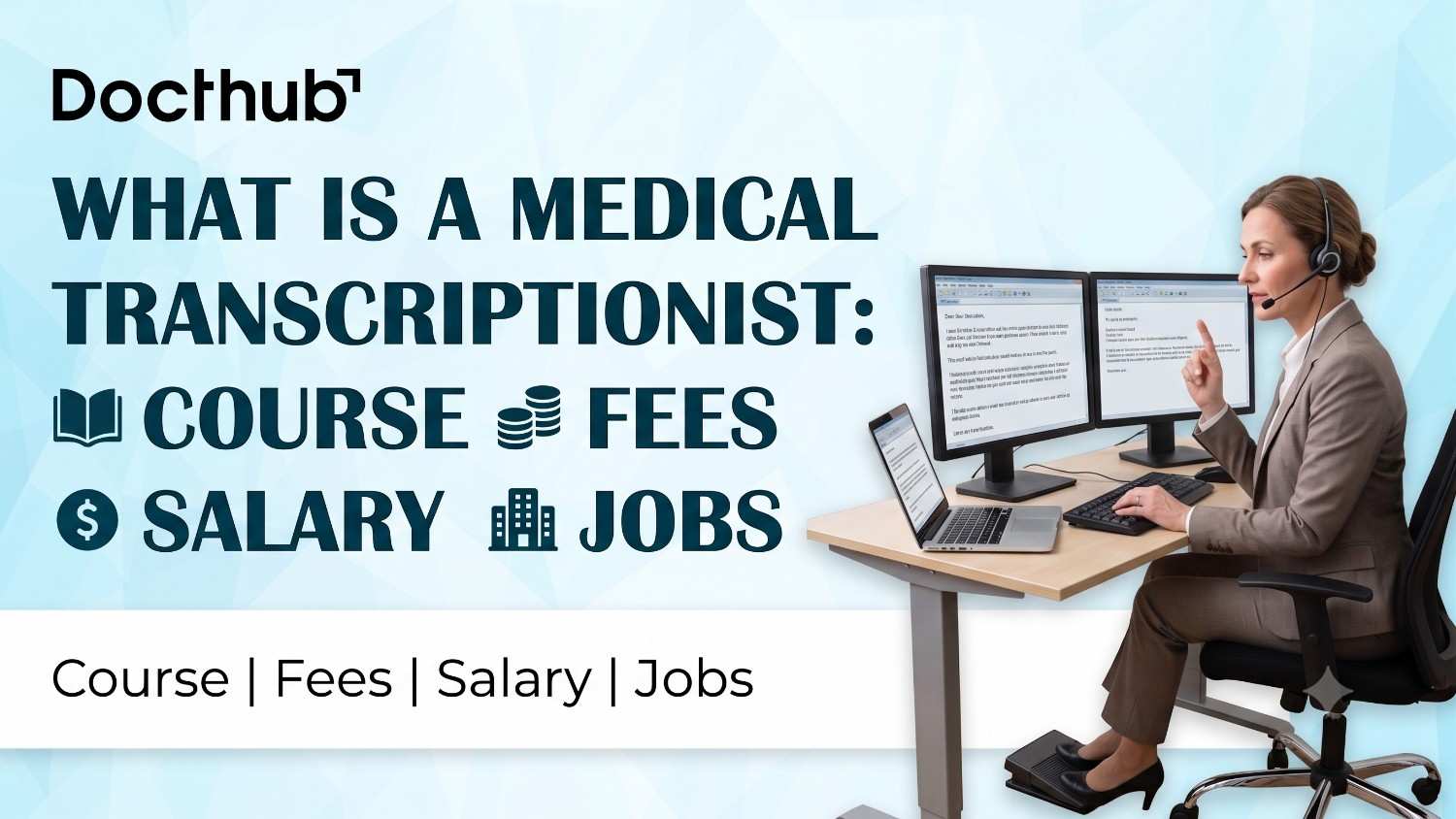
The healthcare sector is not about doctors, nurses, or pharmacists; this sector consists of numerous professionals who help make it smooth and easygoing. Have you thought about the people who convert the voice notes of doctors into precise written documents for the records? Like other healthcare professionals, you don't need a medical degree or background for this; you can still become a bridge between doctors' words and the healthcare system. This is what medical transcriptionists do in their daily transferring audio recordings of notes, documents, and reports into written format. This guide will give you a glimpse of a medical transcriptionist's work life and how to become one.
Who is a medical transcriptionist?
They are healthcare professionals who listen to audio recordings of doctors, surgeons, or specialists, which include patient history, summaries of medical treatment, discharge summaries, operative notes, or reports, to convert them into accurate, concise, detailed documents for the record.
To get into this field, one doesn't require a medical degree; only good English comprehension and computer skills are required. And by enrolling in a course within your time frame for medical transcription, you open doors to a professional path.
How to Become a Medical Transcriptionist
- Complete 12 standards from recognised boards. A science background in 12th is preferred for this, but others can also join, as medical-terminology basics will be covered in the course.
- Medical transcription course: according to your suitable time frame for investment, choose one diploma, certificate, or degree course
- Build skill set: English comprehension, attention to detail, fluency in medical terminology, an idea of anatomy, and knowledge of transcription software.
- Get enough practice and exposure with different internships or projects
- Start applying for fresher or entry-level job roles
Medical transcription course detail
Medical transcriptionist courses are available primarily as certificate, diploma, or degree programmes. Let's discover more about the course.
Course duration:
Course duration mainly depends on the type of course.
- Certificate course – it varies from a few weeks up to 6 months
- Diploma course – it takes 6 months to 1 year based on institute guidelines
- Degree programme – it is a full 3-year programme
Course coverage
This course mainly covers subjects or skill sets required for this job:
- Fundamentals of medical terms, anatomy, and physiology
- Basics of pharmacology
- Grammar, punctuation, and formatting rules in medical writing
- Practice in listening and transcription of different audio files
- Basics of Electronic Health Records (EHR) and transcription software
- Quality control basics in terminology, proofing, and editing
Modes of course:
This training course is available through online, offline, and distance modes of learning. Medical transcription is one of the most online-friendly courses in health care, since the main work – listening and typing – can be fully trained and practised on the computer. Usually, the institutes provide recorded video lectures, online Q&A sessions, and practice dictations in downloadable content.
A handful of institutes run city-based classroom training (Bangalore, Kochi, Thiruvananthapuram, Mangalore, and a few other cities are hubs for this), often paired with lab/practice sessions and direct placement tie-ups with local hospitals or BPOs.
Course Fees
The cost of the course varies based on the institution, level, and way of studying.
- Short certificate courses: They are usually the cheapest type of courses, generally costing from a few thousand to approximately ₹50,000-₹100,000.
- Diploma programmes: Usually priced a bit higher, factoring in a longer duration and more hands-on training.
- Degree programmes (B.Sc./B.Voc.): Being multi-year university-affiliated programmes, these tend to cost more—often in the range of 1.5 to 3 lakh rupees over the full course.
One should compare both institutes as per the cost factors but also check for placement assistance, whether the certification is valuable (NSDC or UGC/NCVET affiliations are good signs), and whether they provide practical exposure in transcription.
Top 5 Recommended Institutes for Certificate or Diploma Course
1. Transorze Solutions (Thiruvananthapuram, Kochi, Bangalore) - Online + Offline
2. Virohan Institute of Health Sciences - Offline (campus-based) + some online support
3. Global Institute of Health Science (GIHS) - Online (self-paced)
4. Cigma Medical Coding Academy (Kochi, Bangalore, Mangalore, Kozhikode) - Online + Offline
5. IISDT – Indian Institute of Skill Development Training - Online
Top 5 recommended institutes for degree courses
- Baba Farid University of Health Sciences, Faridkot (Punjab) — university-affiliated, full-time
- Garware Institute of Career Education and Development (GICED), Mumbai University
- Tagore Institute of Medical Science and Research Centre (TIMS)
- Academy of Medical Transcription, New Delhi
- Indira Gandhi Technological and Medical Sciences University (IGTMU) — notable because it also offers a distance/online certification route, useful if a full offline degree isn't practical for you
Medical Transcriptionist Salary in India
- Entry level – This will start from ₹2–4 lakh per year
- Mid-level – ₹3–6 lakh; if specialisation is pursued in cardiology or radiology, transcription can scale.
- High level – with experience of 5-8 years, can cross ₹5–6 lakh annually, especially in supervisory, quality-analyst, or editing roles.
Some freelancers and remote job workers may earn by the lines of text or audio minutes typed, which allows those fast and precise in their typing to earn much more money in a month.
Job opportunities and career scope
Common employers include hospitals, diagnostic and radiology centres, healthcare BPOs, and dedicated medical transcription service companies — some of which serve international clients. Typical job titles include:
- Medical Transcriptionist
- Medical Editor / Proofreader
- Quality Analyst
- Healthcare Documentation Specialist
- Medical Scribe
As you gain experience, career progression often looks like transcriptionist → editor/QA → team lead → specialisation in a high-value niche (like radiology transcription) or a move into freelance consulting.
As the healthcare sector in India is rapidly digitising records, there remains a steady need for accurate transcription and documentation specialists. Medical transcription should be seriously considered if you’re looking for flexibility, healthcare exposure and a low entry barrier. Just ensure that you opt for a course that has a good track record in placements and recognised certifications. To discover more options like this, visit the website Docthub.
FAQs
Q.1 What does a medical transcriptionist do?
A. They are healthcare professionals who listen to audio recordings of doctors, surgeons, or specialists, which include patient history, summaries of medical treatment, discharge summaries, operative notes, or reports, to convert them into accurate, concise, detailed documents for the record.
Q.2 How long does a medical transcriptionist course take?
A. Certificate courses usually take a few weeks to six months, diploma courses around six months to a year, and degree programmes about three years, depending on the institute and format.
Q.3 Can I learn medical transcription online from home?
A. Yes, medical transcription is one of the most online-friendly courses in health care, since the main work – listening and typing – can be fully trained and practised on the computer. Usually, the institutes provide recorded video lectures, online Q&A sessions, and practice dictations in downloadable content.
Q.4 What are the eligibility criteria for a medical transcription course?
A. Completion of the 12th standard in a recognised board with English grammar knowledge and computer typing skills is required for the course.
Q.5 What is the average salary of a medical transcriptionist?
A. Freshers in India typically earn ₹2–4 lakh per annum, while experienced professionals — especially those with specialisation or editing/QA responsibilities — can earn ₹5–6 lakh or more annually.