CSSD Technician: Full Form, Course, Salary, Jobs, & Scope - High Salary?
CSSD technicians play a key role in healthcare with global job opportunities and strong pay supporting safe medical procedures.

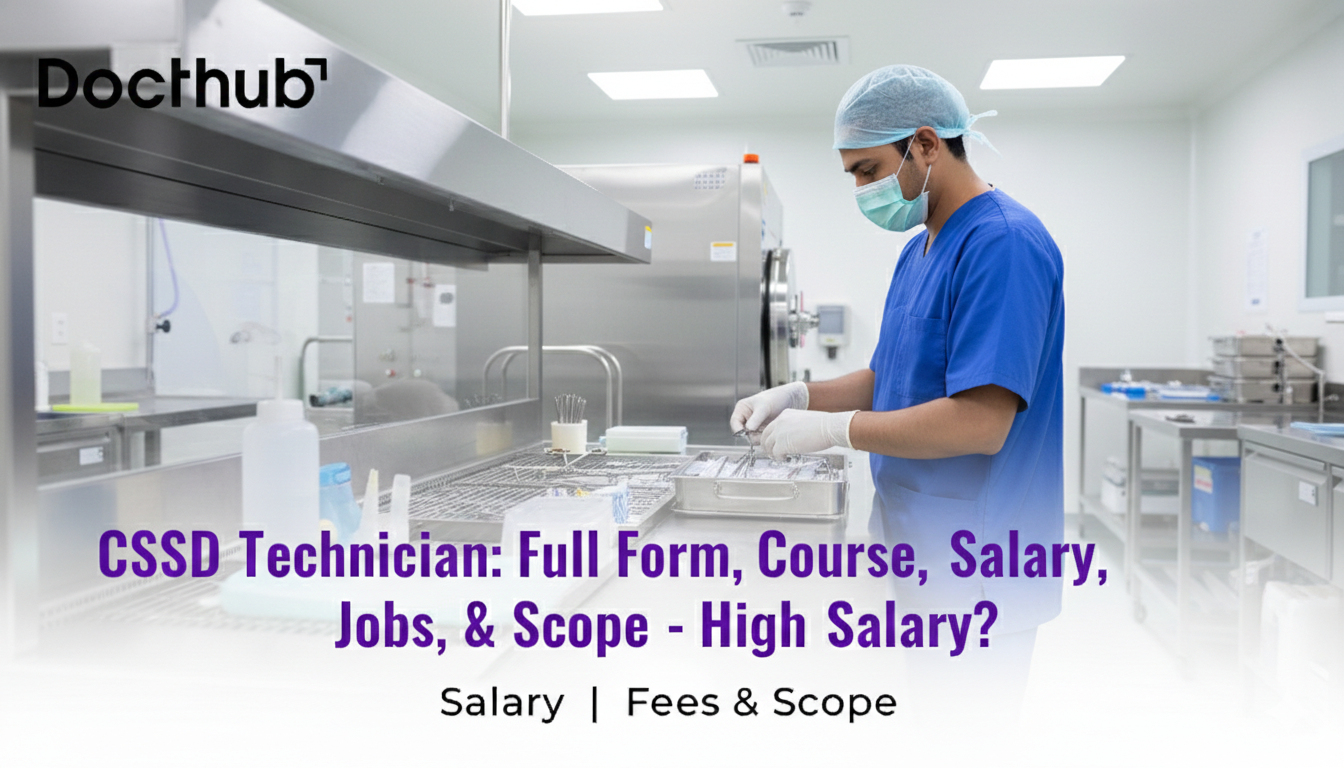
The CSSD Technician plays a key role in ensuring the surgical instruments, and medical supplies that need to be completely sterile, safe, and ready for the treatment of patients in every hospital. This profession combines technical skills, adhering to strict infection control protocols, and keeps the record accurate to prevent the spread of infections in hospitals and support smooth surgical workflows.
This blog details about CCSD Technician, course duration with fees, their duties and responsibilities, and expected CSSD Technician salary per month. It also includes practical information on CSSD Technician job vacancy trends, government jobs for CSSD Technician, and the overall CSSD Technician scope in India, so that you can get clear insight, whether this career offers the stability and growth you’re looking for.
Explain CSSD with its full form?
CSSD stands for Central Sterile Supply Department (also known as Central Sterile Services Department or Central Sterile Services). This CSSD is the important hospital unit that oversees the reusable medical instruments and devices by performing strict inspection in accordance with standard protocols of sterilization, packaging, storing, and distribution for the purpose of utilizing those in operating theatres and other clinical areas.
Roles and Responsibilities:
- The CSSD Technician is to ensure that the reusable surgical materials and medical equipment are well cleaned, disinfected, sterilized, and ready for safe use. It is essential to prevent infections and to support smooth surgical operations in hospitals.
- They collect used equipment during surgery and perform decontamination and sterilization as per the standard protocols using instruments such as autoclaves and ETO sterilizers.
- They are responsible for inspecting instruments for damage or contamination, assembling surgical tools, packing them using sterile wrapping materials, and labelling them correctly for identification and tracking. It ensures that instruments remain sterile until they are needed for medical procedures.
- These technicians maintain records of sterilization cycles, monitor temperature and pressure parameters, track instrument usage, and evaluate the performance of sterilization equipment.
- They help in seamless surgical procedures and help avoid infections in hospitals by ensuring a constant supply of sterile tools to different departments.
CSSD Technician Course with their eligibility:
CSSD Technician courses come under the paramedical programs that help students to gain knowledge for pursuing careers in hospital sterilization departments, operation theatres, and infection control units.
Types of courses:
B.Sc. in Central Sterilization Supply Department (CSSD)
- Duration: Typically, 3 years, sometimes offered as a 2-year program for candidates with a prior diploma.
- Eligibility: 10+2 with Biology, Physics, and Chemistry (PCB), often requiring at least 50% marks
- Fees: ₹1 lakh to ₹4 lakhs.
Diploma Courses in CSSD Technician:
- Duration: It takes 6 months to 2 years. Depending on the institute and course type selected.
- Eligibility: 10th or 12th pass (Science stream preferred).
- Fees: ₹40,000 – ₹1,20,000
Certifications Courses:
- Duration: It takes 3 months to 1 year. Depending on the course type selected.
- Eligibility: Most institutes require a 10th or 12th pass.
- Fees: ₹15,000 – ₹50,000
All these CSSD courses provide strong theoretical knowledge and practical training, that helps the students to work in the Central Sterile Supply Department of hospitals, surgical centers, and healthcare facilities. Students can choose a certificate, diploma, or degree program depending on their career goals and educational background.
CSSD Course Syllabus overview:
CSSD syllabus will focus on building technical skills and gain knowledge about controlling the infection, which are essential for working in hospital sterilization departments.
Most CSSD Technician courses include the following topics:
The following topics were included in the
- Basics of Microbiology
- Infection Control and Hospital Hygiene
- Sterilization and Disinfection Techniques
- Decontamination Procedures
- Surgical Instrument Identification and Handling
- Autoclave and Sterilization Equipment Operation
- Biomedical Waste Management
- Quality Assurance in CSSD
- Documentation and Record Keeping
- Safety Practices in Healthcare Settings
CSSD Technician Salary based on experience:
The salary of CSSD Technician based on their experience is mentioned in the below
| Level | Experience | Salary Range (Per Month) |
| Fresher | 0-1 Year | ₹15,000 – ₹22,000 |
| Mid-Level | 2-5 Years | ₹25,000 – ₹40,000 |
| Senior/In-charge | 7+ Years | ₹45,000 – ₹70,000 |
CSSD Technician job:
The employment opportunities for this role are mostly found in hospitals, surgical centers, medical colleges, and speciality healthcare institutions. Employers usually look for candidates with a CSSD certification, diploma in OT technology, or hospital sterilization training, along with basic knowledge of infection control protocols. Job opportunities are available in both government hospitals and private healthcare organizations, with demand increasing as hospitals expand their surgical services and quality standards. Freshers may start as junior technicians; after gaining experience, these professionals can work as CSSD supervisors or infection-control roles.
For job vacancies, candidates are asked to stay updated with the job portals such as Docthub. For Government job updates, vacancies are usually announced as employment notifications and in specific organisation recruitment websites.
CSSD Technician Scope in India:
The demand for CSSD Technicians in India is increasing as the number of hospitals, surgical centers, and infection-control requirements are high in healthcare institutions. Every hospital requires CSSD technicians in a CSSD unit with an operating theatre, adequate sterilization of surgical tools and medical equipment is required, making them crucial members of the healthcare support team. Opportunities are available in government hospitals, private hospitals, medical colleges, and speciality surgical centers, including institutions like All India Institute of Medical Sciences (AIIMS) and Apollo Hospitals.
After gaining experience, CSSD technicians can progress their career into roles such as Senior CSSD Technician, CSSD Supervisor, OT Assistant, or Infection Control Technician. The demand for trained professionals is increasing as hospitals focus more on patient safety, NABH accreditation standards, and standard infection control protocols. Candidates who hold certificates in sterilization technology and hospital experience often have better employment opportunities both in India and abroad.
Therefore, CSSD technology is a stable paramedical career option with great demand in the healthcare sector. The above-mentioned details such as Course details with an overview of syllabus along with their scope, salary and their roles and responsibilities will benefit those who wish to pursue this career.
FAQs
Q1. What is the full form of CSSD?
A. CSSD stands for the Central Sterile Services Department. (Also known as Central Sterile Services Department or Central Sterile Services.
Q2. What is the average salary of a CSSD Technician?
A. The average salary of a CSSD Technician at an entry level is ₹1.8 to ₹3.5 LPA. With experience, technicians can earn ₹4 to ₹6 LPA. Salaries may vary depending on qualifications, experience, and the healthcare organization type.
Q3. What are the eligibility criteria for the CSSD course?
A. The eligibility criteria to pursue a CSSD technician course; candidates need to complete 10+2 (Science stream preferred) from a recognized board.
Q4. What is the difference between Disinfection and Sterilization?
A. Disinfection is the process of eliminating harmful microorganisms from surfaces and objects, but it will not destroy all bacterial spores. Sterilization is a process which destroys all microorganisms, including spores, bacteria, viruses, and fungi. Sterilization is essential for surgical instruments used in invasive procedures.
Q5. Can I work abroad as a CSSD Technician?
A. Yes, CSSD Technicians can work abroad, especially in countries like the UAE, UK, Australia, and Canada, where trained sterile processing professionals are in demand.