CCU Full Form: Medical Meaning, ICU vs CCU & Career Scope
Understand the CCU full form, ICU vs CCU differences, patient care, and career opportunities in cardiac care.

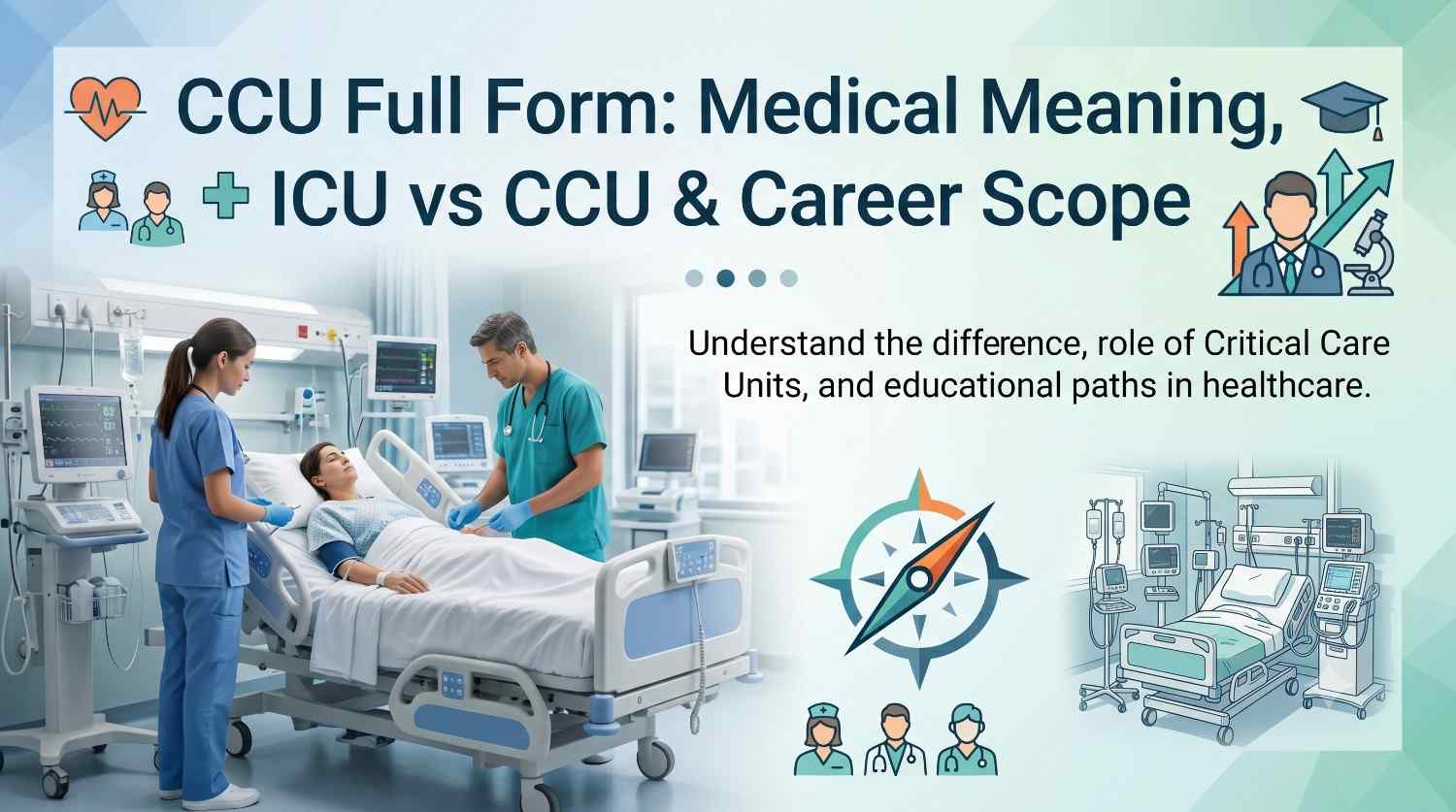
A hospital consists of different departments, specialised rooms, wards, and clinics, which help create an easy flow of the healthcare ecosystem. Those have been given specialised acronyms or terminology to make them easier for healthcare professionals to understand. For a normal individual, it becomes difficult to decode that terminology, but it helps to understand the severity and nature of the patient's condition.
Basic confusion or misunderstanding starts with CCU and ICU. This blog consists of the basic terminology with its detailed explanation.
Terminology for special units in a hospital
Hospitals generally feature many specialised care settings that provide focused care for patients based on their medical condition. Patients are provided with advanced technology and trained healthcare staff in each of these specialised units.
- ICU (Intensive Care Unit): The ICU is for critically ill patients who require intensive treatment and continuous monitoring.
- CCU (Coronary Care Unit): The CCU is specifically designed to care for patients with severe heart disease, as well as cardiac emergencies.
- NICU (Neonatal Intensive Care Unit): The NICU does this specifically for premature and critically ill babies.
- PICU (Pediatric Intensive Care Unit):. The PICU is designed for the care of infants, children, and adolescents with serious conditions
- MICU (Medical Intensive Care Unit): The MICU is specifically designed for medically severe conditions which require intensive treatment.
Various Specialized Care Units in the hospital provide the same types of services to their patients and more by specialising in care for different kinds of patients, depending on the severity and nature of their medical condition.
What is CCU?
The terminology meaning for 'CCU' in hospital and 'CCU' in medical settings, which is Coronary Care Unit or the Cardiac Care Unit, is a specialised unit in a hospital for patients with critical conditions related to the cardiovascular system (heart condition). They require constant supervised care with monitoring and treatment of heart conditions and related complications.
CCU mainly treats or monitors conditions such as
- Acute myocardial infarction (heart attack)
- Severe arrhythmias
- Acute heart failure
- Complications following cardiac surgery
- Unstable angina
CCU is equipped with facilities/equipment such as
- Continuous cardiac monitoring
- Life support equipment
- Diagnostic imaging
- Advanced hydrodynamic support
What is ICU?
ICU is the Intensive Care Unit, which is a specialised ward of a hospital for the critical care of a wide range of life-threatening conditions.
The ICU treats patients with conditions such as the following:
- Respiratory disease which requires a ventilator
- Trauma or accident case
- Complication after surgical intervention
- Infection or sepsis case
- Emergency with neurological involvement
- Multiple organ failure
CCU is equipped with facilities/equipment such as
- Life support equipment with a ventilator and dialysis equipment
- Vital sign monitoring on a continuous basis
- System-specific equipment for monitoring, including neurological mechanics
What is the difference between ICU and CCU? :ICU vs CCU
| Feature | ICU | CCU |
| Full Form | Intensive Care Unit | Coronary Care Unit / Cardiac Care Unit |
| Patient Type | Multi-organ, trauma, post-surgical | Cardiac-specific patients |
| Specialization | General critical care | Heart conditions only |
| Equipment | Ventilators, multi-organ monitors | Cardiac monitors, defibrillators |
| Staff | Intensivists, multi-specialty nurses | Cardiologists, cardiac nurses |
What is the similarity between ICU and CCU?
Even after having huge differences in the ICU and CCU, they share some similar crucial elements to hospital care.
- 24/7 monitoring
- Critical care provided to patient
- Continuous tracking of vital sign with advanced monitoring system
- Highly skilled medical team
- Emergency response and handling of condition
- Maintenance of intensive nursing care
Is CCU More Serious Than ICU?
Seriousness is determined on the basis of the patient's condition rather than the unit. A patient with a risk of cardiac event or condition admitted to CCU, as real-time monitoring is critical for such patients
The hospital shifts the patient from the ICU to the CCU or vice versa based on the patient's condition
If the patient is stabilised from other systemic conditions for which he was admitted but still requires monitoring for cardiac conditions, then transferring from the ICU to the CCU becomes necessary.
Once the other system gets stabilised and there is no need for continuous monitoring, then the patient will be transferred from CCU to the general ward.
Who works in CCU?
The CCU team consists of highly skilled healthcare professionals with expertise in cardiac as well as critical care.
The team consists of a cardiologist, a physician specialised in critical care, nurses, a CCU technician, and a pharmacist.
Together, they provide 24/7 continuous care and monitoring with an individual treatment plan according to the patient's condition.
CCU Technician Career Scope in India: A Growing Opportunity
As per the Indian Heart Association, cardiovascular disease (CVD) is the number one cause of death in India and accounts for more than 28% of all deaths. The need for trained cardiac care professionals is increasing rapidly.
CCU Technician Role
A CCU technician's responsibilities:
- Cardiac equipment operating and handling
- Assistance during the procedure for healthcare professionals
- ECG recording and diagnosis
- Vital sign monitoring and maintenance of record
CCU technician qualification:
- To become a CCU (Cardiac Care Unit) technician, candidates must have:
- Completed Grade 12 Science or equivalent qualification and completed a Diploma/Bachelor’s Degree in Cardiac Care Technology/Critical Care Technology,
- A training/internship component is required along with these qualifications;
- Having certifications for Basic Life Support (BLS) and Advanced Cardiac Life Support (ACLS) can be beneficial to your success.
CCU Technician Salary in India
| Experience Level | Average Monthly Salary |
| Fresher (0–2 years) | ₹15,000 – ₹22,000 |
| Mid-level (3–5 years) | ₹25,000 – ₹40,000 |
| Senior (5+ years) | ₹45,000 – ₹70,000 |
Understanding the difference between ICU and CCU helps patients, families and healthcare professionals regarding critical care setup. While maintaining continuous monitoring, care and support, the ICU treats a wide range of critical care conditions, and the CCU provides care specific to heart-related conditions. With the rising burden of disease in India, a professionally skilled CCU technician offers promising career growth.
For more such job-related guidance and updates, stay connected with Docthub.
FAQs
Q.1: What is the full form of CCU in a hospital?
A: The CCU is a Cardiac Care Unit specifically designed to care for patients with severe heart disease, as well as cardiac emergencies.
Q.2: What is the main difference between ICU and CCU?
A: The ICU is a specialized ward of a hospital for the critical care of a wide range of life-threatening conditions. Whereas CCU is specifically designed to care for patients with severe heart disease, as well as cardiac emergencies.
Q.3: Which patients are admitted to the CCU?
A: Patients with heart attacks, severe arrhythmias, unstable angina, acute heart failure, or post-cardiac surgery are admitted to the CCU.
Q.4. What is the full form of ICU, CCU, and NICU?
A. ICU - Intensive Care Unit | CCU - Coronary Care Unit | NICU -Neonatal Intensive Care Unit.
Q.5: What is the average salary of a CCU technician in India?
A: Typically, a CCU technician's salary ranges from ₹15,000 to ₹70,000+ per month, varying depending on experience, city and type of institute.