BSc Operation Theatre Technology Course Fees, Salary & Scope
Explore BSc operation theatre technology course, fees and future scope

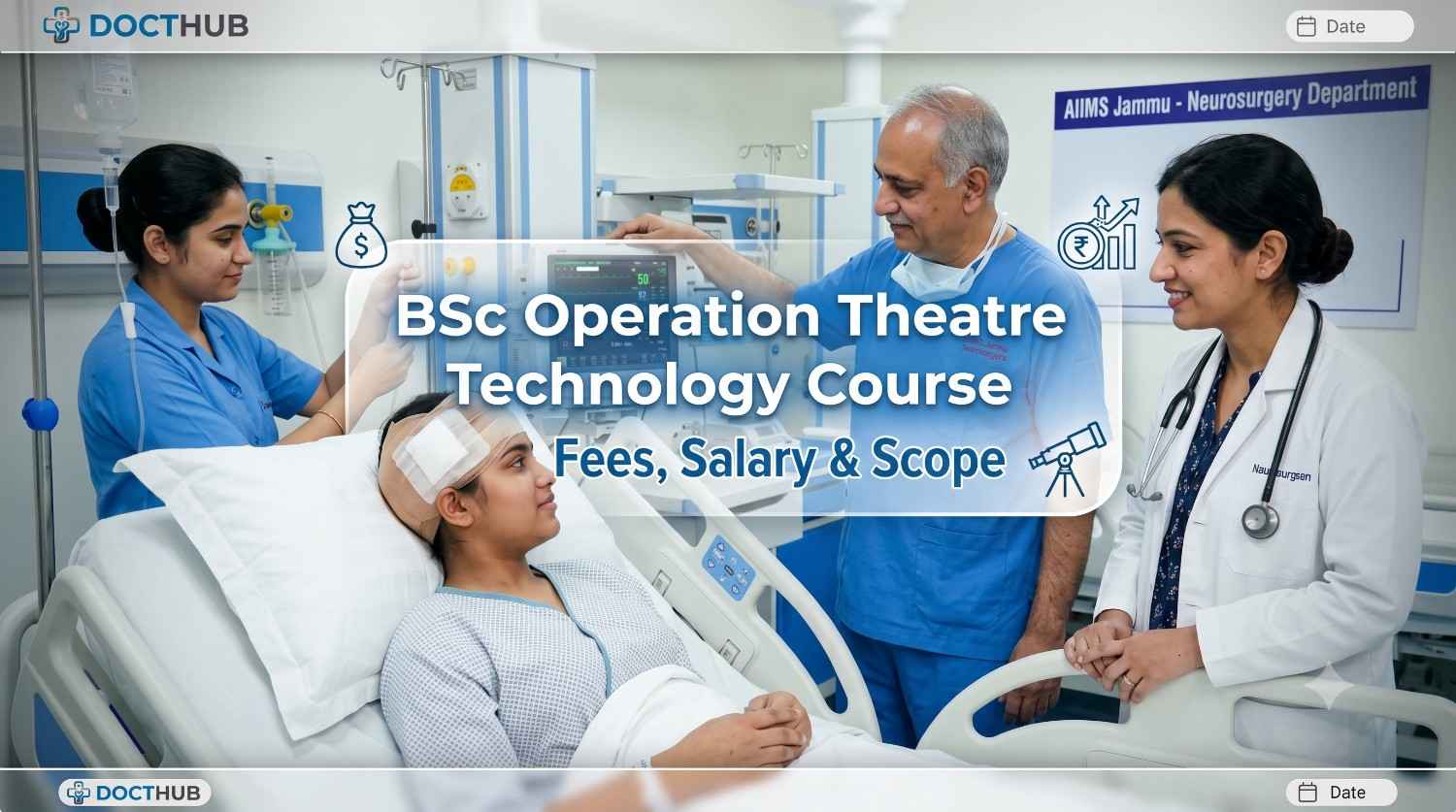
Every hospital may conduct multiple surgeries in a day or may do so at the same time. There are multiple healthcare professionals required to make it smooth and easy with effective results. Doctors or surgeons play a major contributing role in executing surgery, but there is one or more professionals who manage the on-ground 'operation theatre' – an OT technologist. These professionals play a critical role in ensuring that the surgical room remains infection-free and that tools are always within reach. The job of an OT technologist encompasses a wide range of areas, making it one of the most demand-oriented professions in the healthcare industry of India today.
If a student with a 12th-grade science background is entering healthcare as a professional wanting to be in an operating theatre to contribute to procedures, a BSc in Operation Theatre Technology (BSc OTT) will provide the best career. This guide will provide full coverage of the course, fee details, top colleges, salary expectations, and future scope.
What Is BSc Operation Theatre Technology?
BSc OTT is a 3-4 year undergraduate course programme which trains students to assist surgeons and doctors in the operation theatre while assisting other surgical teams. Primarily, students are taught procedures for sterilisation in the operation room, how to set up the instruments, how to handle the anaesthesia equipment, how to control the vital signs during procedures, and how to ensure safety in the operation theatre.
This course was made around a surgical setting. Students spend a large amount of their final years' days in rotating hospital postings to get enough clinical exposure, along with having textbook knowledge.
BSc OTT course details:
Duration:
3 years of academic courses with 6 months to 1 year of internship, depending on university guidelines, making it 3.5 to 4 years of courses.
Eligibility criteria and admission process:
- 12th-science graduate in physics, chemistry, and biology subjects with 55% grades.
- Mainly, admission is taken on the basis of 12th merit, whereas some institutes take their own entrance test.
- Some state-level tests such as BVP CET, AIIMS EE, or CUET-UG. This route is followed by top government/autonomous institutes like AIIMS Delhi and JIPMER Pondicherry.
- Many private universities, such as Brainware University, SVIET University, and NIMS University, do not require any entrance test. They take admission based on 12th merit marks.
- It is advised to verify from the official university site before applying for the course.
Syllabus:
The BSc in Operation Theatre Technology has a syllabus which is designed to blend theory with clinical practice. Although the titles differ slightly in different universities, the courses are generally offered like this:
Year 1: Human anatomy, human physiology, biochemistry, and introduction to hospital and OT management
Year 2: Microbiology, pharmacology, pathology, anaesthesia technology, and disinfection work
Year 3: Advanced surgeries, operation theatre administration, critical care support, and internships
There may also be some courses on soft skills like communication with patients, emergency response, and record-keeping. This is due to the fact that a person with such training needs to work closely with a surgeon, anaesthetist, and nurses while working.
Course Fees:
OT technician course fees in India generally range from the following:
- Government colleges: Roughly ₹20,000 to ₹80,000 for the entire course
- Private colleges: Anywhere between ₹1.5 lakh and ₹4 lakh for the full duration, depending on infrastructure, hospital tie-ups, and location
Colleges in metro cities and those affiliated with large multi-speciality hospitals tend to sit at the higher end of that range, mainly because they offer better clinical exposure and placement support.
Top 10 government colleges
- AIIMS (multiple branches – Delhi and others)
- JIPMER, Puducherry
- PGIMER, Chandigarh
- SGPGIMS, Lucknow
- CMC Vellore
- NIMHANS, Bengaluru
- Sri Jayadeva Institute of Cardiovascular Sciences, Bengaluru
- King George's Medical University (KGMU), Lucknow
- Government Medical College, Bangalore Medical College and Research Institute (BMCRI)
- Rajiv Gandhi Paramedical Institute, New Delhi
Top 10 Private Colleges
- Manipal Academy of Higher Education (MAHE)
- SRM Institute of Science and Technology
- Amrita Vishwa Vidyapeetham
- Symbiosis Institute of Health Sciences
- Jain University, Bangalore
- Amity University
- St. John's Medical College, Bengaluru
- Vydehi Institute of Medical Sciences and Research Centre, Bengaluru
- RajaRajeswari Medical College, Bengaluru
- NIMS University, Jaipur
Operation Theatre Technology Salary & Scope
Salary:
This aspect becomes most important and crucial for students, helping in deciding the suitability of a career path.
Entry-level (0–2 years): ₹15,000 – ₹22,000
Mid-level (3–6 years): ₹25,000 – ₹40,000
Senior/specialised roles (7+ years): ₹45,000 – ₹70,000 or higher, especially in cardiac, neuro, or transplant surgery units
Variation in this salary scale can be seen based on location, work experience, skill, and type of hospital or organisation. One can achieve a higher scale by pursuing a certification course or specialisation in an area of interest.
Career Scope
The scope for BSc OTT graduates extends well beyond just working as an OT technician:
- OT Technologist / Surgical Technologist in hospitals and nursing homes
- Anaesthesia Technician, assisting anaesthetists during procedures
- Central Sterile Supply Department (CSSD) Technician, managing sterilisation of surgical instruments across the hospital
- OT In-charge / Manager, after gaining a few years of experience
- Medical equipment sales and support roles, for those interested in the technical side of surgical devices
- Teaching and training positions in paramedical institutes, for graduates who pursue further postgraduate studies
Higher Education & Certifications After BSc OTT
Master's Degree Choices
- MSc in Operating Theatre & Anaesthesia Technology — ideal for someone who would like to pursue specific clinical operations in operating theatres rather than switch careers. Generally consists of 2 years of study and is offered by both government institutions such as AIIMS, PGIMER, JIPMER, and various private universities.
- Master of Hospital Administration – allows one to move from performing clinical tasks on operating tables to working in hospital administration.
- MBA in Healthcare Management – a degree for graduates opting for a managerial position, rather than the purely clinical one.
Options for earning a PG diploma and certificate:
- Advanced PG Diploma in Operation Theatre Technology, which is distinguished by the fact that it lasts from 1 to 2 years and is provided at a cost of approximately Rs.50,000 to Rs.100,000, depending on the educational institution.
- Entrance exams for PG courses – the postgraduate courses in operation theatre operation technology normally require the student to take the CUET PG test or the GAHET test. However, diploma programmes usually only require confirmation of merit.
- Shiksha
- Neurosurgery Technology programme – The focus of the course is to train people to work in the area of neurosurgery operations in the OT.
- Certificate courses in pain management, anaesthesia and intensive care programmes are short courses allowing people to start their careers in adjacent areas of medical expertise without getting a postgraduate diploma.
As the healthcare sector is expanding on a larger scale, which requires additional hospital surgical centres and specialisation, there is a demand for such healthcare professionals who can work in operating theatres.
The demand is quite genuine, particularly in the Gulf countries. There are thousands of job openings for OT technicians in the UAE and elsewhere. Recruiters are on their toes searching for candidates for the position of OT technicians primarily in countries like the UAE, Bahrain, Kuwait, Malta, the Maldives, Oman, Qatar, and Saudi Arabia, in addition to the USA and the UK. In fact, the salary for the entry-level positions in the Gulf is significantly higher than the Indian salaries, as the starting pay for the Gulf OT technicians in the USA is about $2,200 and may reach $4,000.
This course suits those who can perform well in long working hours and high-pressure environments and make contributions in the operating theatre. It is a highly technical and hands-on job that brings one right in the middle of each and every operation. For more details on job opportunities and further certification courses after OTT, visit Docthub.
FAQs
Q.1 Is NEET required for B.Sc Operation Theatre Technology?
A. No, NEET is generally not required for BSc OTT admissions. Mainly, admission is taken on the basis of 12th merit, whereas some institutes take their own entrance test. It is necessary to check the official website before applying for admission criteria.
Q.2 What is the average salary of an OT technician in India?
A. On average, an OT technician in India earns somewhere between ₹18,000 and ₹35,000 per month, depending on experience, employer type, and city. Those working in large private or corporate hospitals, or specialising in areas like cardiac or neurosurgery, often earn on the higher end of this range.
Q.3 What is the difference between B.Sc OTT and B.Sc Nursing?
A. Both do coursework in a hospital setting, but the focus is a bit different. BSc Nursing students work under comprehensive patient care, starting from before treatment starts till patient discharge. BSc OTT is centred in the operating theatre for assisting in surgery, managing sterilisation and instrument setting, making OTT more specialised and technical.
Q.4 What are the main job roles after completing B.Sc OTT?
A. Qualified persons commonly get employed in hospitals and surgical centres as OT technologists, anaesthesia technicians, or CSSD technicians. With experience, the majority shift to OT management and supervisory jobs, while some go on to become medical device salesmen or trainers or enter a teaching field.
Q.5 Can B.Sc OTT graduates work abroad (like UK, UAE, or USA)?
A. The demand is quite genuine, particularly in the Gulf countries. There are thousands of job openings for OT technicians in the UAE and elsewhere. That said, working abroad usually requires clearing country-specific licensing exams or certifications, along with meeting visa and credential-verification requirements. In fact, the salary for the entry-level positions in the Gulf is significantly higher than the Indian salaries, as the starting pay for the Gulf OT technicians in the USA is about $2,200 and may reach $4,000.