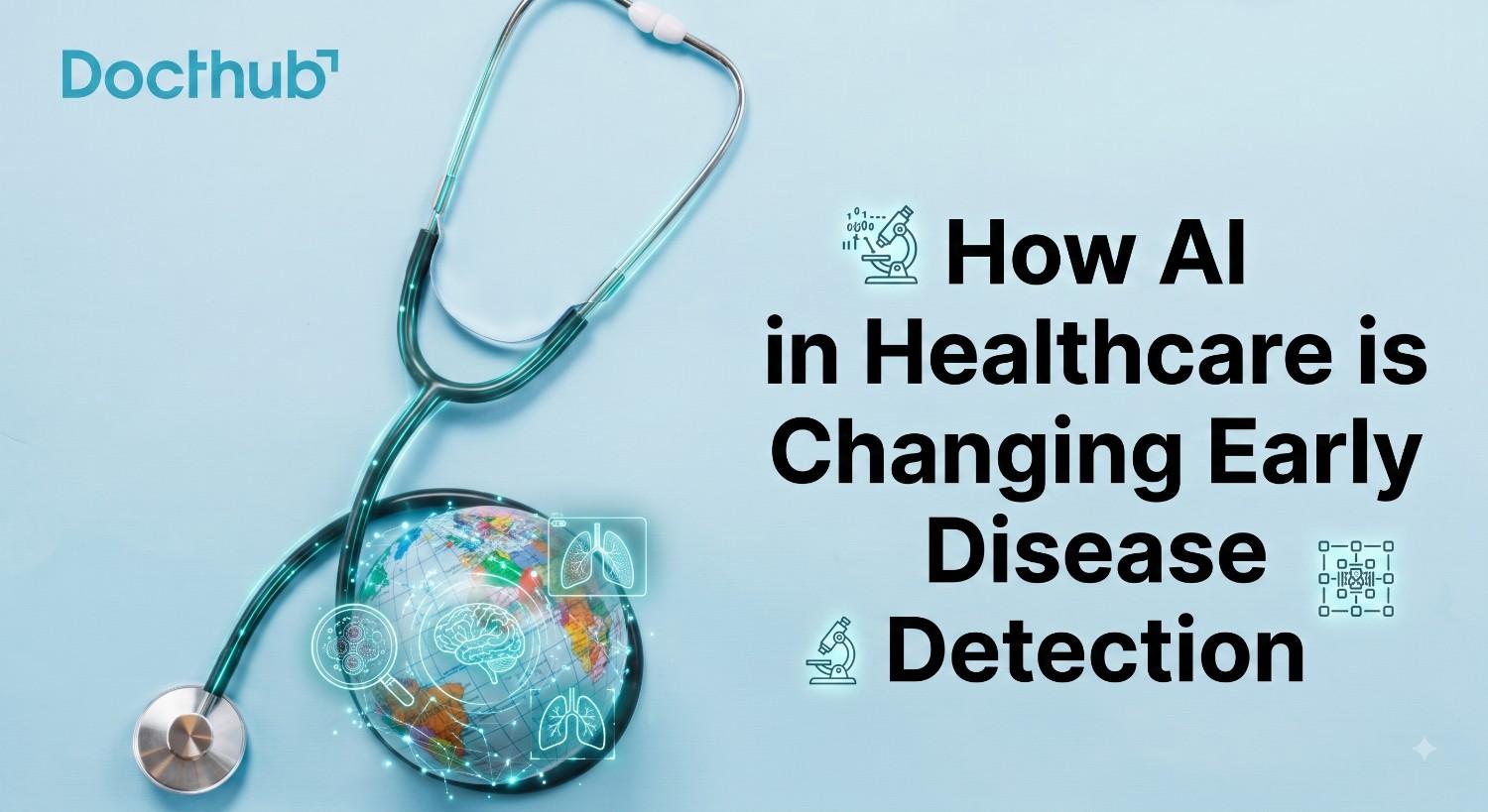
How AI in Healthcare is Changing Early Disease Detection
Explore AI in healthcare and how it help in early disease diagnosis

What if a disease could be spotted before your body showed its first warning sign?
Most diseases become treatable with good results in the early stage, but they are hard to detect. That gap is exactly what AI in healthcare is starting to close. The AI incorporation in healthcare has been revolutionary, changing the path of patient diagnosis, treatment, and monitoring. It has a vast impact in the medical field, from research to documentation and treatment to patient engagement. AI has helped healthcare in the aspect of analysing large data in minutes, assisting in detecting disease markers, risks, and health trends.
What is AI in healthcare?
The term “AI in healthcare” includes a wide range of machine learning tools. Some scan medical images for subtle patterns. Others review electronic health records or genomic data to estimate future risk. Still others monitor wearable device signals for early physiological changes. In combination, these approaches are changing the way doctors think regarding screening, diagnosis, and preventive measures.
The tale of artificial intelligence development for health care started with IBM’s Watson, one of the first AI tools launched in the early days of artificial intelligence. In the year 2011, IBM introduced a healthcare version of Watson that made use of natural language processing technology for understanding and analysing health data. This was one of the pioneering examples of AI in healthcare being used to enhance decision-making processes in real life. These days, IBM has captured the interest of companies like Apple, Microsoft, and Amazon, which are pouring in huge amounts of money into artificial intelligence technology for the healthcare sector.
AI in medical diagnostics
Most major diseases follow a similar pattern – early diagnosis gives a better chance of recovery and a better outcome. Cancer detected at stage 4 has a poor prognosis and less chance of survival than diagnosed at stage 1, which opens up options for treatment and the recovery process. This is true when it comes to cardiovascular or neurodegenerative diseases, or any type of infection. Diagnostic tests such as mammograms, colonoscopies, or blood tests that are already in use have saved lives, but they have some shortcomings, such as the need for human intervention, waiting for the report, and dealing with tonnes of data.
It mainly works on the basis of reviewing vast amounts of data and distinguishing healthy conditions from early disease situations. This operates in much the same way as a machine learning algorithm. For instance, a mammography reading model is created by training it on a vast array of mammograms that were previously captured, all of which are labelled as being either "normal" or "diseased" by professionals. As the model sees more examples of early-stage disease, it begins to create a mathematical embodiment of the process.
The study conducted by Harvard Medical School in 2023 demonstrates how this works. Scientists trained a model using data on disease codes and timing patterns from millions of patient records, even including codes that are not associated at all with the pancreas. The model was good at finding those patients who were the most likely to get pancreatic cancer, which is hard and costly to screen for in practice. Interestingly, though, its predictive accuracy is equivalent to that of genetic sequencing tests in terms of accuracy.
Examples of AI in Healthcare Today
- AI-driven stethoscopes — A device invented at Imperial College London can identify heart failure, valve problems, and irregular heartbeats in approximately 15 seconds by using a combination of ECG signals and sound analysis.
- Retinal image analysis — Google DeepMind Health exhibited AI technology capable of making eye disease diagnoses based on retinal scans with precision equivalent to specialists.
- Population-wide cancer testing — In India, Telangana state has initiated trials of AI-supported screening for oral, breast, and cervical cancers as a means of combatting the shortage of radiologists.
- Continuous monitoring with wearables — AI-based wearables monitor heart health with an ECG, glucose levels, and blood pressure, revealing abnormal characteristics.
How AI Detects Cancer Early
Cancer remains the area where AI-assisted detection has the most real-world traction, largely because so much cancer screening relies on image data. AI technology transforms the way in which cancer is diagnosed and speeds up the process. The main idea is that technology can discover exact cases of cancer at an early stage, sometimes even before symptoms appear, which is crucial.
1. Examining Medical Images
- Breast Cancer – Artificial intelligence interprets mammograms with the help of specialists and finds anomalies
- Lung cancer – Artificial intelligence works with low-radiation computed tomography images with the aim of detecting small nodules indicative of early-stage cancer and decreasing chances of missing this indicator in the environment of mass screenings.
- Thyroid cancer – AI in ultrasound enables the confirmation of the benign nature of the lump and can occasionally save the patient from an unnecessary biopsy.
- Pathology – AI examines tissue slide images for any early changes in cells in a more consistent way than the traditional method.
2. Predicting Health Risk through Medical Records
- Examination of the complete history of the patient
- Study of past medical conditions, test evaluation, and drug details helps to understand the possibility of cancer before it occurs
3. Blood Tests and Genetic Diagnostics
An approach hatched relatively recently allows for the avoidance of conventional imaging and biopsy. Indeed:
- Liquid biopsy – AI reviews the DNA fragments found in blood to identify a number of types of cancer.
- Genetic analysis – AI is able to help with understanding the DNA structure of the tumour in order to ascertain how it will respond to therapy.
Benefits of AI in Early Diagnosis
- Fast assessment at scale- Artificial intelligence can analyse vast amounts of imaging and laboratory data that would take human teams a lot longer to analyze.
- Detecting what can be overlooked. It is the tiny details, such as the slightest hint in an imaging scan or a change in blood reports, that AI was designed to notice.
- Elimination of extra procedures. Accurate readings at earlier stages, in cases like the ultrasound example of the thyroid, can sometimes save the person from an unnecessary invasive biopsy procedure.
- More people get the benefits of advanced testing. Predictive models, like the pancreatic cancer example, show AI can approximate expensive genetic testing for a much wider group of patients.
AI in Disease Prevention
While early detection is concerned with identifying the signs of disease that has already developed, prevention aims to eliminate the disease before it starts. As AI becomes a major aspect in healthcare, it opens the door for its role in the preventive aspect of disease.
- Risk Scoring: The use of artificial intelligence in examining patient records and lifestyle helps with early identification of risk for diseases such as heart disease and diabetes. It gives time for clinicians to start preventive measures and execute the treatment plan in advance.
- Continuous Monitoring: Real-time health monitoring is becoming possible with AI technology, which allows a timeframe for detection and response for conditions.
- Large-scale Screening: Telangana AI-assisted cancer screening helps to monitor cancer in areas where medical facilities are limited; these can help to screen large populations.
- Personalised Prevention Plans: AI technology makes it possible to generate personalised plans that would take into account one’s health condition, lifestyle, and environment.
How Accurate Is AI in Early Disease Diagnosis?
Accuracy differs for various reasons, such as condition, quality of dataset, and the setting in which it is deployed. In the case of the pancreatic cancer study mentioned above, the model was superior to regular population risk estimators, and its accuracy was similar to genetic testing accuracy. When it comes to imaging, several AI-enabled screening devices are equal to specialists in terms of accuracy in certain tasks with a clearly defined narrow scope.
A study conducted in 2025 and published by the American Medical Association points to the fact that 66% of physicians use some type of health-related AI technology as opposed to 38% in 2023, with 68% of respondents stating that the technology has a positive effect on patients' treatment.
Challenges of Using AI in Disease Detection
- Data privacy – Data is a very sensitive aspect of medical care, which gives rise to issues related to the safety and usage of data.
- Bias and fairness – Models based on already existing data sometimes condition other than training data, making them difficult to diagnose.
- Liability – It is unclear whether an AI-based diagnosis that causes damage can be blamed on the maker of the AI, the hospital, or the doctor treating the patient.
- Integration difficulties – Most of the healthcare providers are still using outdated data management technology, making it impossible for AI tools to be seamlessly integrated.
- Over-dependence issue – Experts warn that artificial intelligence should enhance clinical judgement, rather than replace it.
AI - Healthcare Courses
The growing interest towards AI in the domain of healthcare has led to the launch of numerous learning courses at various levels of proficiency, from novice to executive. The courses generally include foundational principles of machine learning in medical applications such as medical imaging and electronic health records (EHR), the use of machine learning techniques using technologies such as TensorFlow and PyTorch, as well as important legal and ethical issues, including data privacy and bias. Most of the modules entail real-life examples and practical exercises involving patient behaviour with healthcare systems.
Examples of such courses include
- Stanford's AI specialisation in healthcare – which culminates in a capstone project utilising patient experience data and medical imaging to predict health risks;
- Microsoft's Azure AI in Health Care Professional Certificate – which emphasises the development of practical projects using Azure tools for those in health IT or transitioning careers;
- Harvard Chan's AI in Health Care Certificate – tailored for high-level professionals like chief medical officers and data scientists.
AI in healthcare has come a long way from its theoretical application in different sectors to practical usage. Even though AI isn't perfect and doesn't replace the doctor's decisions, it can be an effective instrument to change the treatment of patients and raise the level of healthcare. For more healthcare and AI-related course details, visit Dochub.
FAQs
Q.1 What diseases can AI detect early?
A. AI can detect early cancer stages with imaging, pathology reports, or risk prediction. Also help in cases of diabetic retinopathy, infections, and cardiovascular disease via ECG monitoring or research in that field for neurodegenerative conditions.
Q.2 How does AI detect diseases before symptoms appear?
A. This process requires detection of particular patterns contained in images, laboratory test results, and other continuously gathered physiological statistics, as well as using other aspects like the health condition history of the patient or disease codes that correspond to symptoms.
Q.3 How accurate is AI in early disease diagnosis?
A. Accuracy differs for various reasons, such as condition, quality of dataset, and the setting in which it is deployed. When it comes to imaging, several AI-enabled screening devices are equal to specialists in terms of accuracy in certain tasks with a clearly defined narrow scope.
Q.4 Will AI replace doctors in diagnosing diseases?
A. Evidence supports collaboration rather than replacement. AI generates results fast while doctors put the results in context, interpret them, talk to patients, and take responsibility. Using AI works better when used in conjunction with human workers rather than independently.
Q.5 What are the main challenges of using AI in disease detection?
A. Limitations of AI include generalising results from one group of people to another, privacy, integration with work processes, liability, training doctors, dealing with false positives and false negatives, and ensuring human input.